Blog
PHOSGO Go5 Prototype Review | A Useful Solar-Powered E-Bike?

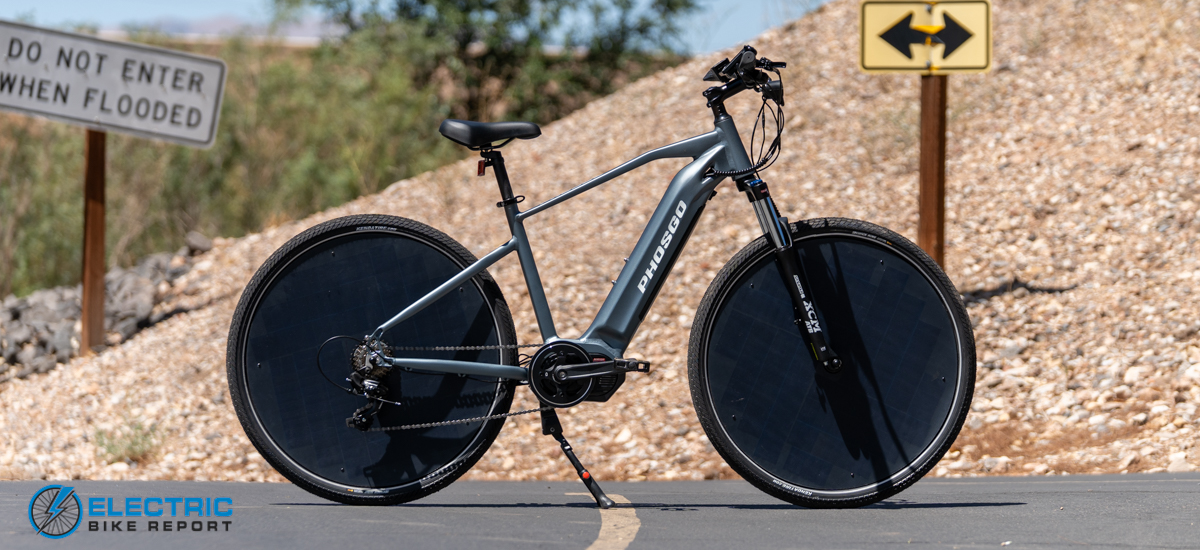
Given PHOSGO’s marketing, our Range Test was perhaps the most interesting of our standardized performance tests.
We rode the bike on a network of paved shared-use paths, starting with a full charge and riding until the battery was depleted. In typical fashion, we performed separate tests using the highest and lowest pedal assist levels, though the Go5 Prototype’s solar panels added an extra dimension to our process.
We ran two max-power tests—one with the solar panels connected to the bike’s system and the other with them disconnected—to see what effect they had on the bike’s range.
In our PAS 1 test, we were pleased to note that the Go5 Prototype met PHOSGO’s advertised claim of 62 miles. In PAS 5, the bike traveled 23.8 miles with solar panels connected.
Before addressing the impact of the solar panels, let’s pause to consider this baseline performance in relation to similar e-bikes we’ve tested. Similar commuter-style e-bikes we’ve reviewed averaged 37.1 and 74.0 miles on batteries averaging 715 Wh, so while the Go5 Prototype had lower range results, this is understandable given its smaller-than-average 499 Wh battery.
In terms of energy consumption, the prototype straddled the averages among similar models; our group of comparison e-bikes used 10 watt-hours per mile (Wh/mi) in their low-assist tests and 19.5 Wh/mi in their max-power tests, while the Go5 used 8 Wh/mi and 21 Wh/mi, respectively.
Ultimately, while its high-power result is on the low end of the spectrum, we can say that most riders should expect to get at least one full round-trip commute before needing to recharge. Others may be able to extend that to multiple trips, depending on where and how they ride.
Again, with its 499 Wh battery and 500W motor, our test bike is most similar in specs to the production Go5 Pro model, which has a 500W mid-drive and a 480 Wh battery. The Go5 Ultra has a 750W motor and a 720 Wh battery, which we would expect to provide similar range given the more powerful motor, though whether these bikes share our test bike’s speed limits is just one factor that will influence their range.
Now, to continue with our explanation of test results, the Go5 covered 27.3 miles with its solar panels unplugged. This means that, while we had different riders perform our two max-PAS tests, the bike actually performed better with its solar panels disconnected. Case in point: its energy consumption dropped from 21 Wh/mi to 18.3 Wh/mi.
As you might understand, this result was unexpected, but there may be a good reason for it.
We noticed that, when the bike’s battery was below 20%, its power delivery became very inconsistent. At first, the motor shut off, but after pedaling for a short time without power, it would temporarily turn on again. We decided to stop the test earlier than expected, since the pedal assist system was essentially not helpful at this point.
Upon reaching out to our contact at PHOSGO, we were advised that the bike’s battery management system (BMS) was likely to blame. As a protective feature on our prototype e-bike, the BMS was set to reduce the battery’s output voltage upon reaching 20%; this explains the motor cutoff. After settling, the voltage likely raised above the protective threshold, turning the motor back on again until the voltage dropped again.
Our contact also advised us that the company’s development team was aware of this issue and that a fix would be implemented on production models. While we hope this to be true, we can only report on our findings.
To supplement this range testing, we tested the solar panels’ functionality in two different ways: while riding and while parked. While riding, we found that the solar panels only send energy to the battery after at least 5 seconds of coasting and if the wheels get relatively direct sunlight.
When parked, the solar panels did work to recharge the battery, though at a relatively slow rate; we accumulated roughly 3% of the battery’s charge per hour. A rider leaving their bike parked in the sun for an 8-hour work day could expect to recover roughly 24%, while a full charge would require roughly 33 hours of direct sunlight.
One factor to note is that the bike must be left on while charging. As such, it may need to be secured by a good lock (or multiple security mechanisms) to prevent theft.
Ultimately, our test bike demonstrated usable range for leisure rides and daily commutes, so it should accommodate most riders’ needs. Its solar panels, however, will best work for those traveling relatively short distances who can leave their bike in the sun for comparatively long periods of time.