
Blog
Addmotor Freetan M-368X Full-Sus Semi-Recumbent eTrike Review

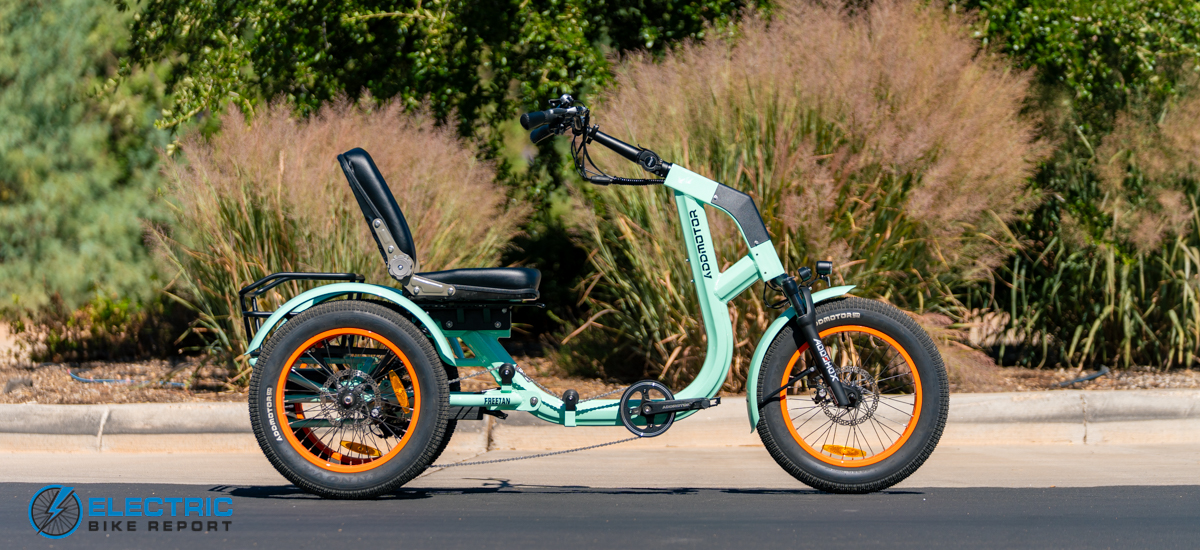
While the Freetan M-368X has performed well in the sections detailed above, ride quality is perhaps its greatest strength. As I touched on in the introduction to this review, this trike is geared towards comfort, but the overall package is well-rounded.
Addmotor offers a single frame size with a recommended fit range between 5’1″ and 6’7″. With its relatively large footprint, this is understandable; shorter riders may be able to find a comfortable seating position and throttle around, but the Freetan is clearly designed with average to tall riders in mind.
At 5’11”, I felt perfectly accommodated, which was no shock given the trike’s huge range of adjustability. Riders can adjust the padded seat’s backrest angle and its longitudinal position (it moves forward and back on rails). It’s also possible to adjust the handlebars’ vertical positioning with a rotating adjustable stem, their longitudinal position via a telescoping function, and their sweep/angle by loosening the stem’s top plate and rotating their position.
As a semi-recumbent trike, the Freetan’s seating position is relatively uncommon; riders aren’t fully reclined, but tilted backward somewhere between a supine and upright position. With this design and the forward location of the bottom bracket, pedaling feels like more of a forward movement than a downward one.
The result is a relaxed, supported, and enjoyable ride. All in all, it’s one of the most adaptable and comfortable setups I’ve encountered, which means that it’s almost guaranteed that the majority of riders should be able to find a suitable fit. The Freetan’s remarkably low standover height of 11.4″ also makes it incredibly easy to get on and off – provided you can push or pull yourself up from the seat.
In terms of handling, the Freetan is relatively unique for a delta-style (one wheel in front, two in back) trike. More compact delta-style trikes tend to be tippy when cornering, but the Addmotor’s long wheelbase helps it to feel more stable in comparison; it’s still possible to tip up on two wheels when cornering sharply at higher speeds, but overall, the trike feels generally planted.
It’s worth mentioning the Freetan’s steering mechanism; there’s a noticeable angle in its steering column formed by a universal joint (shrouded by a removable cover plate). This allows the handlebars to rotate more vertically instead of horizontally. It’s a cool setup that makes this semi-recumbent design work.
Combined with the Freetan’s 20×4″ fat tires, it also has the benefit of giving this trike very responsive steering. Small movements of the handlebars translate to impactful (but still predictable) changes in direction. In my experience, this approach fits the Freetan’s relaxed vibe well.
Those tires are worth mentioning more about, too—they have a unique hybrid tread (I call them “city knobs”) that balance traction with low rolling resistance. They performed well on both paved surfaces and pea gravel, making the Freetan suitable for cruising streets, paved paths, and relatively smooth dirt or gravel multi-use trails.
The tires also work well in conjunction with the trike’s full suspension. It is equipped with a beefy 80mm suspension fork and two coil shocks beneath the seat. In my experience, larger dips and bumps were still noticeable, but the ride was generally smooth and comfortable most of the time.
As I touched on in the Speed Test section above, the Freetan’s 750W motor definitely puts some power behind the ride. There’s ample muscle for tackling hills and accelerating, though it generally stays controlled and easy to manage.
One thing I didn’t hit is how the motor engages. Addmotor’s website explains that the trike uses a combination of both torque and cadence sensors, though in my experience, the Freetan is much more cadence-based than torque-based.
While there did seem to be some responsiveness to power output based on my pedal pressure, most of the time, the motor delivered steady output as long as I turned the cranks. The result is an easy experience that’s suitable for new riders and those looking for a casual, low-effort feel.
In terms of its features and accessories, the Freetan M-368X is well-equipped without being overloaded. It includes fenders, a rear cargo basket, integrated lights and turn signals, an electronic horn, and side mirrors. It also has a button to deactivate the throttle, which can eliminate the possibility of accidentally engaging it, or instantly limit the trike to Class 1 functionality if riding in a location where throttles are not allowed.
I’ve mentioned a few areas with room for improvement, but I’d like to include a few more under the same overarching theme. Along with hydraulic brakes and a faster charger, I’d love to see a color display, lock-on grips, and a reverse throttle function to increase the Freetan’s overall value. These are relatively small upgrades that would greatly enhance the trike’s already great user experience.
A final word about the trike’s user interface; the black-and-white display, while basic, is well-organized and completely usable. There are a handful of customization options that can be accessed through a simple settings menu—things like speed, backlight brightness, etc.
The Freetan does not pair with Addmotor’s app, but it can still be used to get turn-by-turn navigation, to track rides, and to interact with other Addmotor riders via a social-media-like platform.
All in all, the Freetan M-368X offers a lot, including a remarkably adjustable and comfortable ride. Many of these features are above and beyond what we’re used to seeing on e-trikes, though with the Freetan’s price point of roughly $3,300 (at the time of writing), they are things that you should expect to pay more for.